
Most small business digital marketing strategies start the same way: someone sets up a Facebook page, or maybe runs a Google Ads campaign for a few months, and then wonders why the results don’t last. The problem isn’t the channels — it’s using them in isolation. SEO, social media, and paid advertising each have real strengths, but they’re dramatically more effective when they work together as a coordinated strategy. We call this the Growth Stack.
This guide explains what the Growth Stack is, how each channel contributes, and how to build one even on a limited budget.
Why Single-Channel Marketing Fails
Relying on one marketing channel is like building a house with one wall. It might feel stable for a while, but any disruption — an algorithm change, rising ad costs, a negative review spike — can knock your lead flow to zero.
We’ve seen it happen repeatedly. A business runs Google Ads successfully for two years, then the account gets suspended or costs double overnight. Another business builds its entire presence on Facebook, then organic reach collapses (as it famously did around 2018). Single-channel dependency creates fragility. A diversified strategy builds resilience.
The Growth Stack Framework: Three Channels, One Strategy
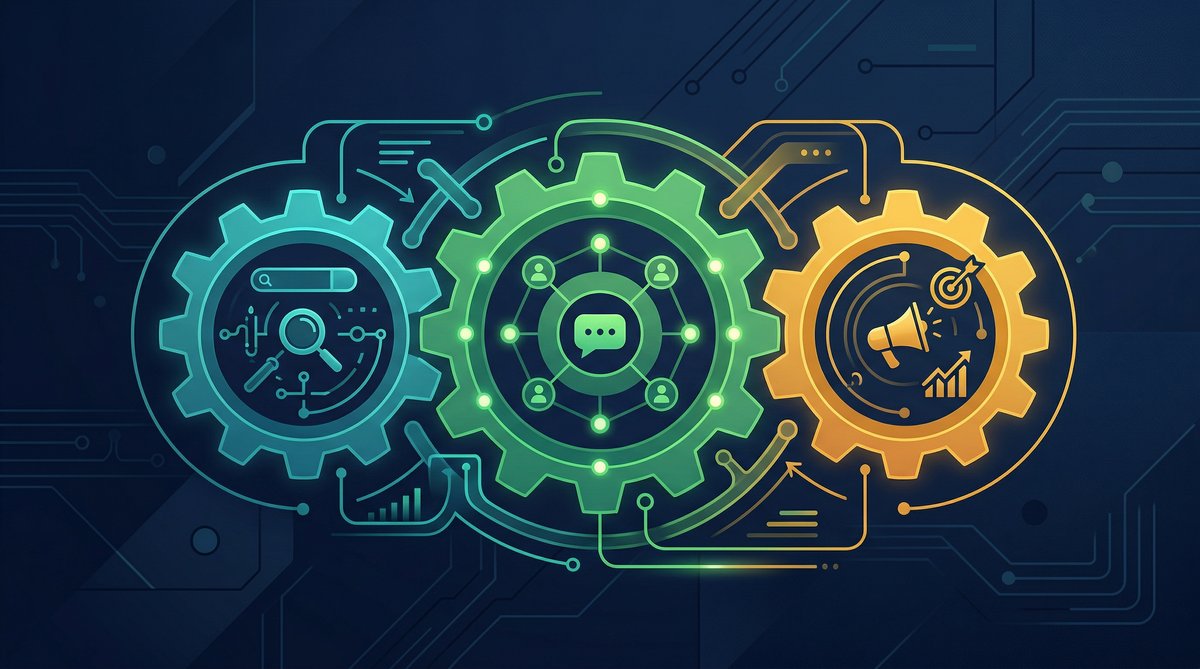
The Growth Stack for small businesses is built on three channels that each serve a distinct purpose in your customer journey:
- SEO: Captures demand from people already searching for what you offer. Long-term, compounding results. Builds authority.
- Social Media: Builds awareness and trust with your target audience over time. Creates a warm audience for your other channels.
- Google Ads: Generates immediate visibility and leads. Controllable, measurable, scalable.
Together, these three channels cover the full funnel — awareness, consideration, and conversion — while reinforcing each other in ways that make the whole more powerful than the sum of its parts.
SEO: The Long Game That Compounds
Search engine optimization is the channel most small businesses underinvest in because the results take time. But that’s exactly what makes it so valuable once it takes hold. Organic search rankings, unlike paid ads, don’t stop working the moment you stop paying.
A well-optimized website ranks for dozens or hundreds of search queries simultaneously. A blog post written today might generate leads two years from now. A Google Business Profile optimized for local search drives phone calls every week without additional spend. Over a 12–24 month timeline, SEO typically delivers the lowest cost per lead of any digital channel — making it the foundation of any sound small business digital marketing strategy.
The catch is that it requires patience and consistency. Most businesses don’t see significant SEO results for the first three to six months. That’s where the other channels carry the load in the meantime. Learn more about our approach to local SEO for small businesses.
Social Media: Building Trust and Community
Social media’s role in the Growth Stack is often misunderstood. Businesses treat it as a place to post promotions and wonder why it doesn’t drive sales. The real function of social media is trust-building and top-of-mind awareness.
When your business shows up consistently on the platforms where your customers spend time — sharing useful content, responding to comments, giving people a look behind the scenes — you build a relationship before anyone asks for money. By the time a social media follower needs what you sell, you’re not a stranger cold-pitching them. You’re a familiar, trusted resource.
Social media also feeds your other channels. Content from your blog (built for SEO) becomes social posts. Your Google Ads campaigns retarget people who’ve engaged with your social content. The channels create a flywheel effect when connected intentionally.
Google Ads: Immediate Visibility and Leads
While SEO builds momentum over months, Google Ads generates results on day one. For a small business that needs leads now — not in six months — paid search is the fastest path to visibility in front of high-intent searchers.
Google Ads also provides something SEO and social can’t: precise, measurable data. You know exactly how much you’re spending, which keywords are converting, and what each lead costs you. That data is invaluable for understanding your market and informing your broader digital marketing strategy.
The limitation of Google Ads is that it stops when you stop spending. That’s why it’s a Growth Stack component — not a standalone strategy. The leads you generate through ads can be nurtured into long-term customers who then leave reviews, follow you on social, and recommend you to friends. The channels build on each other. Explore our Google Ads management service to see how we approach this.
How the Three Channels Reinforce Each Other
This is where the Growth Stack framework really earns its name. Here’s how the channels amplify each other in practice:
- SEO + Social: Blog content created for SEO gets promoted on social media, driving traffic and social signals that reinforce search rankings. Social engagement builds an audience that amplifies your content organically.
- Social + Ads: Ads can retarget people who’ve visited your website or engaged with your social content — a warm audience that converts at much higher rates than cold traffic.
- Ads + SEO: Paid search data reveals which keywords actually convert, informing your organic SEO strategy. High-converting keywords are worth targeting with content, not just bids.
- All three: A customer might find you through a Google search (SEO), start following you on Instagram (social), see a retargeting ad that brings them back (ads), and then book an appointment. Without all three channels working, you likely lose them somewhere in that journey.
Building Your Growth Stack on a Budget
You don’t need to run all three channels at full capacity from day one. For a small business with limited marketing budget, here’s a practical sequencing approach:
- Month 1–3: Launch Google Ads for immediate leads while building your website SEO foundation. Start posting on social to build a small but engaged following.
- Month 4–6: Begin creating SEO content (blog posts, service pages) targeting local search queries. Maintain social consistency. Optimize ad spend based on data from the first three months.
- Month 7–12: SEO starts delivering organic leads. Ads can be refined to focus on highest-value conversions. Social audience is growing and adding to retargeting pools.
By the end of year one, you have three channels contributing to growth — and each one is making the others more effective.
Case Study: What a Coordinated Strategy Looks Like
Imagine a local landscaping company that was previously running Google Ads but with no social presence and no SEO strategy. Their cost per lead from ads was high, and they had no presence in local search results.
With a coordinated Growth Stack approach: we optimized their Google Business Profile and website for local search (SEO), launched a consistent Instagram and Facebook presence showcasing before-and-after project photos (social), and refined their Google Ads to focus on the highest-converting services with retargeting to prior website visitors (ads).
Within six months, their organic leads had doubled, their ad cost per lead dropped by 40%, and their social following had grown from a few hundred to several thousand engaged local followers. The channels were feeding each other. That’s the Growth Stack in action.
The Growth Bundle: All Three in One Package
Managing a complete digital marketing strategy across SEO, social, and paid search takes significant time and expertise. For small businesses that want all three channels working together without the overhead of managing multiple agencies or contractors, we offer a Growth Bundle that integrates all three into a single, coordinated strategy managed by our team.
Talk to our team about what a Growth Stack strategy looks like for your specific business and budget.
Ready to Build a Marketing Strategy That Actually Compounds?
Our Growth Bundle brings SEO, social media, and Google Ads together into a single, coordinated strategy managed by our team — so your channels reinforce each other instead of operating in silos.
How does your business compare locally?
Find out in 60 seconds with our free visibility scan.
Run My Free Scan →

